
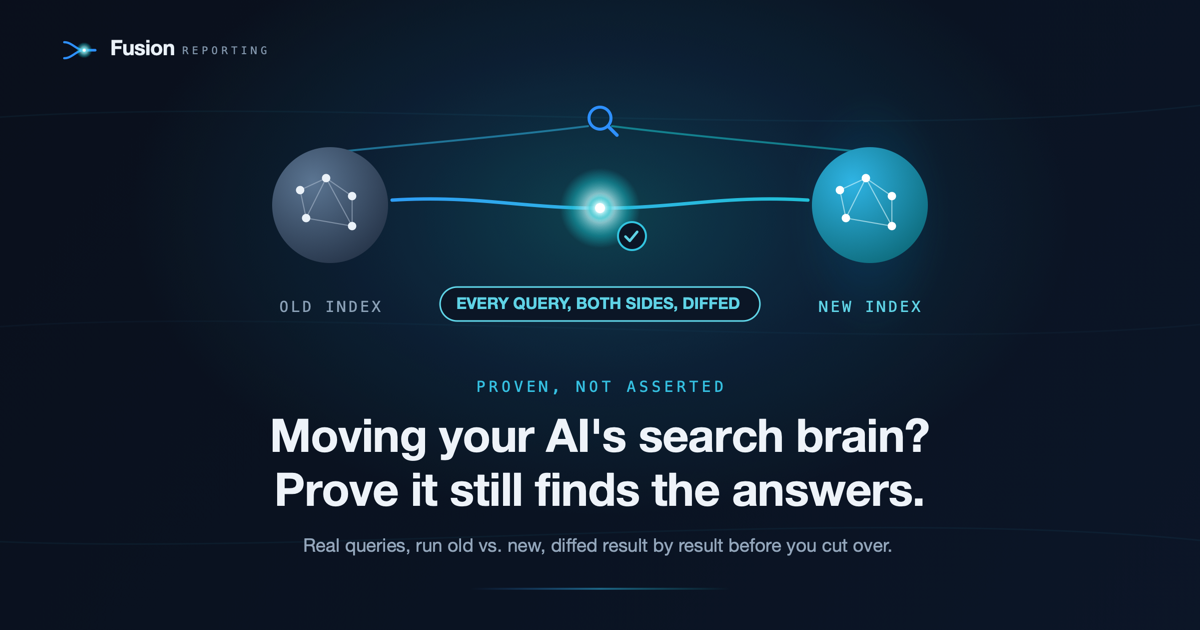
Moving your AI's search brain? Prove it still finds the right answers
The issue. If your product has an AI feature — a support bot, a document search, a "chat with your data" tool — there's a search engine behind it that finds the right passages before the AI answers. That engine is built on a vector database and an embedding model, and sooner or later it gets rebuilt: you switch databases, or the model that built your index is retired and everything has to be re-encoded. Here's the trap: every migration tool on the market moves the data, and not one of them checks whether the AI still finds the right answers afterward. We looked. One major vector database's official tool migrates data in from fourteen competing systems and performs no search-quality check at all; another vendor's tool offers only "basic data validation" — it counts records, it doesn't test results. A leading vendor's own documentation states it has no export function, and that its recommended platform migration silently drops writes made mid-move. The move can "succeed" while the search quietly gets worse — and nobody knows until customers complain.
Why now. Microsoft has scheduled the retirement of all three OpenAI embedding models on Azure — ada-002, 3-small, and 3-large — for April 15, 2027. After that date the models simply stop responding. Embeddings can't be auto-upgraded the way chat models can: vectors from different models are incompatible, so every Azure OpenAI customer with an AI search index has to re-embed their entire content and rebuild before the deadline. And this isn't a one-off — Microsoft's lifecycle policy now retires models on a regular clock, and OpenAI already shut down sixteen earlier embedding models in a single day back in 2024. To be clear, the rebuild itself is cheap: even ten million documents costs on the order of a few hundred dollars in re-embedding fees. The risk isn't the bill. The risk is shipping a rebuilt index that finds worse answers, silently.
How it works.
- We capture your real queries. Not benchmark data — the actual questions your users ask, pulled from your logs, plus the searches your team knows must work.
- We run them against old and new, side by side. Before you cut over, both systems answer every query, and we record exactly what each one returns.
- We diff the results. Which queries return the same answers, which shifted, and which broke outright — measured query by query, not eyeballed.
- We walk you through the go/no-go. We review what changed, you fix what needs fixing, we re-run until the numbers say it's safe — or we tell you plainly that it isn't yet.
What you get. A written verification report: every query tested, every result that changed, and a clear answer to the only question that matters — is it safe to switch?
The benefits.
- Cut over with evidence, not hope — "spot-check a few searches and ship" is how quality breaks silently.
- We're neutral. Database vendors only verify moves into their own product; we don't care which system wins.
- Same discipline as our SQL Server–to–PostgreSQL migrations, where we compare every table on both systems and prove zero differences before cutover — applied to AI search.
- Fixed fee, agreed up front. You know the cost before we start.
If you're facing the Azure 2027 deadline — or any rebuild of the search behind your AI — we'll prove it's safe before you flip the switch.
Want it handled? → curt@fusionreporting.com