
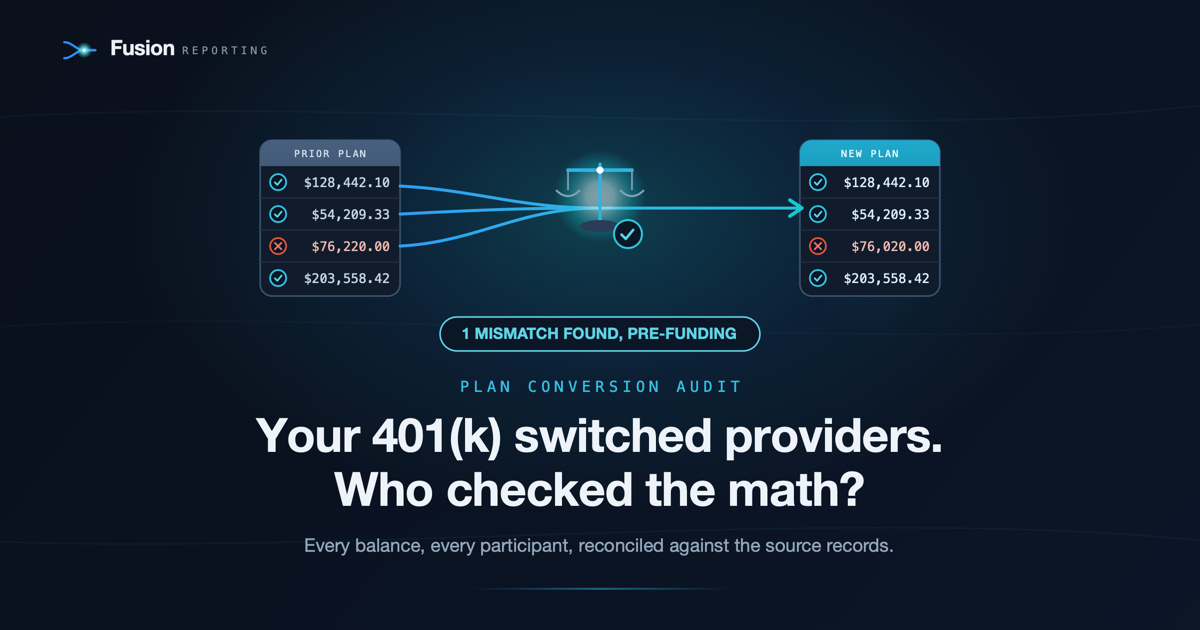
When your 401(k) plan switches providers, who checks the math?
The issue. When a company moves its 401(k) or 403(b) plan to a new recordkeeper — the firm that tracks every employee's retirement balance — every dollar has to move perfectly. Not just each person's total: every "money bucket" inside it (employee contributions, employer match, old rollovers), every vesting percentage, every loan schedule, all mapped from one company's computer system into another's. Here's the uncomfortable part: usually nobody independently checks that it all arrived. The old provider hands off, the new provider loads, and everyone trusts the transfer worked.
Why this matters now. Provider switches used to be rare. Not anymore — the recordkeeping industry has consolidated hard, from roughly 400 providers fifteen years ago to about 50 today, by a CAPTRUST retirement-industry consultant's count. Every merger and buyout forces plans to convert, whether the employer wanted to move or not. And when a transfer goes wrong, the legal exposure lands on the employer, not the provider: under federal retirement law, the plan sponsor stays responsible for errors in its plan even when a vendor caused them. A federal lawsuit filed in 2025 shows what that looks like — an employee alleges his balance came up roughly 9% short after his employer's plan changed recordkeepers. To be clear, that's one unproven allegation in one case, not an industry statistic. But it's exactly the kind of claim an independent check either catches early or proves wrong.
How it works. This is the same discipline we apply when businesses move databases — compare the old system and the new system record by record and prove they match — pointed at retirement plans, where the rows are people's savings:
- We take the final records from the old provider and the opening records from the new one. Any format they come in — extracts, conversion files, statements.
- We tie out every participant, every money bucket, to the penny. Balances by fund and by source, vesting percentages, outstanding loans — each one matched old-to-new, not sampled.
- We explain every difference. Some gaps are legitimate — market movement during the transfer window, fees, timing. We separate those from real errors: dropped accounts, mis-tagged money sources, mapping mistakes.
- We report in plain English. Not a spreadsheet you have to decode — a clear list of what matched, what didn't, and why.
What you get. A written discrepancy report covering every participant in the plan: either "everything ties out, here's the proof," or "here are the exact accounts and amounts to fix — before employees find them." Either answer is worth having on file.
The benefits.
- Every account verified — not spot-checked, not assumed.
- Errors caught while the old provider's records still exist and fixes are easy.
- A documented independent check the employer can point to if a question ever comes up.
- A fixed fee per conversion, quoted up front — no hourly meter.
We work with employers directly, and with the TPAs, advisors, and audit firms that run conversions and want an independent data specialist behind them.
If your plan just switched providers — or is about to — and no one outside the two recordkeepers has verified the transfer, that's exactly the check we run.
Want it handled? → curt@fusionreporting.com